
For millennia, explorers have been enthralled by the wonders and mysteries of the aquatic world. From colorful coral reefs brimming with life to the tranquility of deep-sea sceneries, diving offers a singular chance to get up close and personal with this hidden world. Enrolling in a diving school is the ideal approach to safely and securely explore the ocean’s depths if you want to know where to begin. The several kinds of diving courses that are offered, the advantages of enrolling in them, and what to anticipate from the theoretical and practical training involved will all be covered in this article.
Diving Course Types
Courses for diving from the Deep Blue Dive Center are made to accommodate a range of interests and skill levels. Regardless of your experience level, there is a course that will help you improve your diving abilities. The most common categories of diving courses are broken down as follows:
- Course for Open Water Divers
The most well-liked beginning certification for novices is the Open Water Diver Course. It covers the fundamentals of scuba diving, such as using equipment, communicating underwater, and practicing critical safety techniques. After finishing this course, you will be qualified to dive with a friend down to 18 meters (60 feet).
Essential Knowledge Acquired:
- Utilizing scuba equipment to breathe underwater.
- Balancing the pressure in your ears.
- Basic safety and navigation procedures for buoyancy control.
- Course for Advanced Open Water Divers
The Advanced Open Water Diver training is perfect for people who want to advance their diving abilities. While honing their general diving skills, this Deep Blue Dive Center course enables divers to experiment with several styles, including deep diving, wreck diving, and night diving.
Essential Knowledge Acquired:
- Techniques for deep diving (up to 30 meters/100 feet)
- Navigating underwater using a compass
- Low-visibility and night diving
- Drift diving and buoyancy optimal performance
- Course for Rescue Divers
Safety is a vital component of diving, and the Rescue Diver training focuses on giving divers the tools they need to deal with crises. Divers who wish to boost their confidence and learn how to help people in need should take this course.
Essential Knowledge Acquired:
- Techniques for self-rescue.
- Identifying and controlling other divers’ stress.
- Utilizing equipment and managing emergencies.
- Taking care of emergencies involving dives, like terrified or unresponsive divers.
- Courses for Specialty Diving
Divers can study particular areas of interest and hone specialized abilities through specialty courses. Among the examples are:
- Taking breathtaking pictures of underwater scenery and marine life is known as underwater photography.
- Investigating submerged ships and other structures is known as wreck diving.
- Cave Diving: Exploring tunnels and caverns beneath the surface.
- Using enriched air (Nitrox) to decrease nitrogen absorption and increase bottom duration is known as “nitrox diving.”
- Courses for Professional Diving
Professional-level courses, such as the Divemaster and Instructor certifications, are available for those who want to make a living from their love of diving. These classes concentrate on dive planning, managing other divers, and developing leadership abilities.
Advantages of Enrolling in Diving Courses
Beyond simply exploring the undersea environment, diving lessons have many more advantages. The following are some of the main benefits of earning a diving certification:
- Confidence and Safety
Diving can have inherent risks because the ocean is unpredictable. To ensure you’re ready for anything, diving courses offer in-depth instruction on safety protocols, emergency responses, and equipment handling. This training increases your confidence, making diving more pleasurable and stress-free.
- Adventure and Exploration
Exploration and adventure can be found in diving. Diving gives you a unique perspective on the undersea world, whether you’re swimming with vibrant fish, exploring historic shipwrecks, or discovering hidden caverns. With the correct training, you can explore exceptional aquatic environments and reach unprecedented depths.
- Advantages for Mental and Physical Health
Since diving works for different muscle groups and enhances cardiovascular health, it’s a great way to keep active. Furthermore, being submerged has a meditative impact that can improve mood, lower stress, and support mental health. The body and the psyche may benefit from the weightlessness that diving provides.
- Knowledge of the Environment
Learning to dive frequently results in a more profound respect for the environment and marine life. Many diving courses cover responsible diving techniques, the value of preserving coral reefs, and marine conservation. Divers who possess this information are better equipped to promote ocean conservation.
- Social Networks
You can meet people sharing your love of the water by diving, a social activity. Group dives, dive clubs, and dive vacations are all excellent means of meeting new people, exchanging stories, and creating enduring connections.
Training in Both Theoretical and Practical Diving
Diving courses offer a thorough educational experience by combining theoretical and practical instruction. What to anticipate from each component is as follows:
Training in Theory
The fundamental information required to dive safely is covered in the theoretical portion of diving lessons. Typically, this entails attending classes or taking online courses where you study:
- Diving Physics: Understanding ideas like buoyancy, pressure, and how depth affects the body.
- Diving Physiology: Learning about the body’s reactions to underwater conditions, such as decompression sickness and nitrogen absorption.
- Diving Equipment: Getting acquainted with tanks, wetsuits, buoyancy control devices (BCDs), and regulators.
- Dive Planning and Safety: Understanding dive tables, creating safe dive profiles, and utilizing dive computers are all part of dive planning and safety.
Real-World Instruction
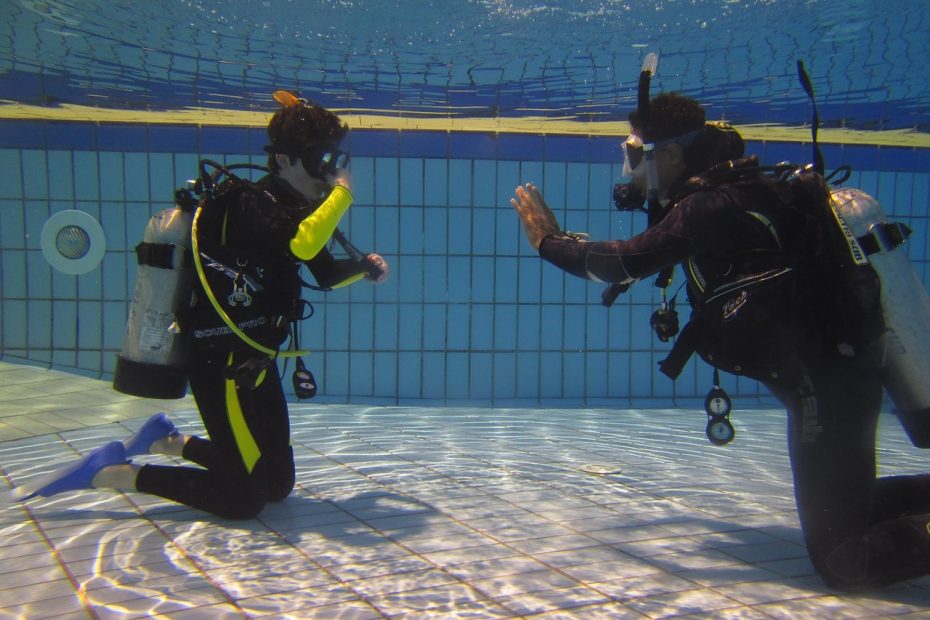
The fun starts with the hands-on instruction! You will apply your theoretical understanding to open-water dives in the ocean after engaging in hands-on activities in a supervised setting, like a pool. Essential components of hands-on training include:
- Confined Water Dives: These are drills in a swimming pool where you can learn the fundamentals of diving in a shallow, secure setting.
- Open Water Dives: Once you have mastered the fundamentals, you will advance to open-water dives, usually done in a big lake or the ocean. Here, under the supervision of a qualified educator, you will use your abilities in practical settings.
- Skill Evaluations: During the course, you will be evaluated on several abilities, including underwater navigation, mask clearing, and regulator recovery.
With the promise of safety and the excitement of adventure, diving courses are your ticket to exploring the deep sea. There is a course for everyone, regardless of experience level, whether you are a novice who wants to sample scuba diving or an expert diver seeking to improve your abilities. By enrolling in a diving course, you can acquire the capabilities, know-how, and self-assurance required to explore the undersea environment responsibly.
Why wait, then? Discover the secrets of the deep sea, embark on your next journey, and take in the breathtaking splendor of the ocean’s depths. Have fun diving!
